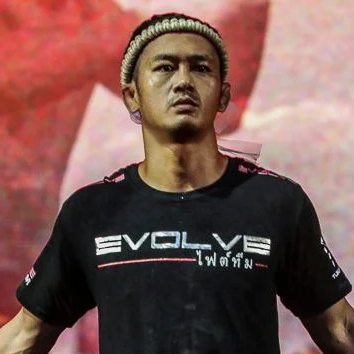
I started fighting because my family needed the money. That is the honest answer. Most Thai fighters from Isaan will tell you the same thing.
What I did not expect was what the ring would teach me. Not just how to fight — but how to think. How to stay calm when everything is going wrong. How to read a person before they know what they are going to do themselves. These are things that do not have a name in Muay Thai, but every champion knows them.
The Record
Lumpinee Stadium title at 108 lbs in early 1990. Multiple Channel 7 Stadium World Titles from 2007. North East Thailand Championship. Andaman League Tournament Champion. Over 200 professional fights across three decades.
In 2018 and 2019 I competed in ONE Championship, bringing Muay Thai to the international stage. Different rules, different judges, different opponents — but the same art.
What I Fought
I came up in the golden era of Thai fighting — the 1990s, when Lumpinee and Rajadamnern were the only arenas that mattered and every fight card had four or five future champions on it. You learned fast or you did not last. There was no internet to study opponents. You watched from the corner, you felt things in sparring, and you asked your Kru questions until he told you to stop asking and start feeling.
I fought in small provincial stadiums for 500 baht and in Lumpinee for the kind of money that meant my mother did not have to work in the fields anymore. Both mattered. Both taught me different things.
Why I Share This
When I started coaching, I noticed something. Students would copy what I showed them — the mechanics, the pattern — but they could not use it in sparring. The technique was right but the understanding was missing.
The problem is how most Muay Thai is taught. You learn movements, not principles. You learn what to do, not when, not why, not what it feels like when it is about to work.
I spent three decades building this understanding. It would be a waste to take it to the grave.
What Gets Lost in Teaching
When you teach punch and kick, the student learns the pose and stops there. They focus on the limb — how hard, how fast — and forget it is a whole coordination of the entire body. The hip, the shoulder, the weight shifting from one foot to the other. A punch is not an arm doing something. It is everything arriving at the same moment through the arm.
The second thing that gets lost is the opponent. The student becomes so focused on performing the technique correctly that the other person disappears. But the other person is the whole point. Their fear, their habits, the way their weight shifts before they throw — all of that is information. A fighter who reads this has an answer before the question is finished.
This is what thirty years built in me. Not just the technique. The whole-body coordination, and the reading. Most fighters develop one or the other. Very few build both that deep.
Why Your Turn Comes First
The knowledge I carry was never learned through words. It came through sparring, through mistakes, through watching opponents until the patterns became automatic. It lives in my body — in reactions I have before I think.
That is why every challenge here asks you to go feel it before you read the answer. Not because the answer is hidden. Because the answer will not land until your body has something to attach it to. You read the situation, you go to training, you try it yourself. Then you come back. Now the words mean something.
That is the only way this kind of knowledge travels. Not from mind to mind. From body to body, with words as the bridge.
The journal works the same way. When you write down what confused you in training, you are not just recording — you are starting to see. The pattern you keep running into becomes visible when you put it in words. That is when it becomes something you can bring to Kru. Not a vague feeling. A specific problem. And a specific problem is one that can be answered.
Where to start